Vitrectomy Devices Market to Reach USD 2.51 Billion by 2031 as Demand for Advanced Retinal Surgery Technologies Increases
Hyderabad – Nov 6th, 2026 –
Vitrectomy Devices Market Overview
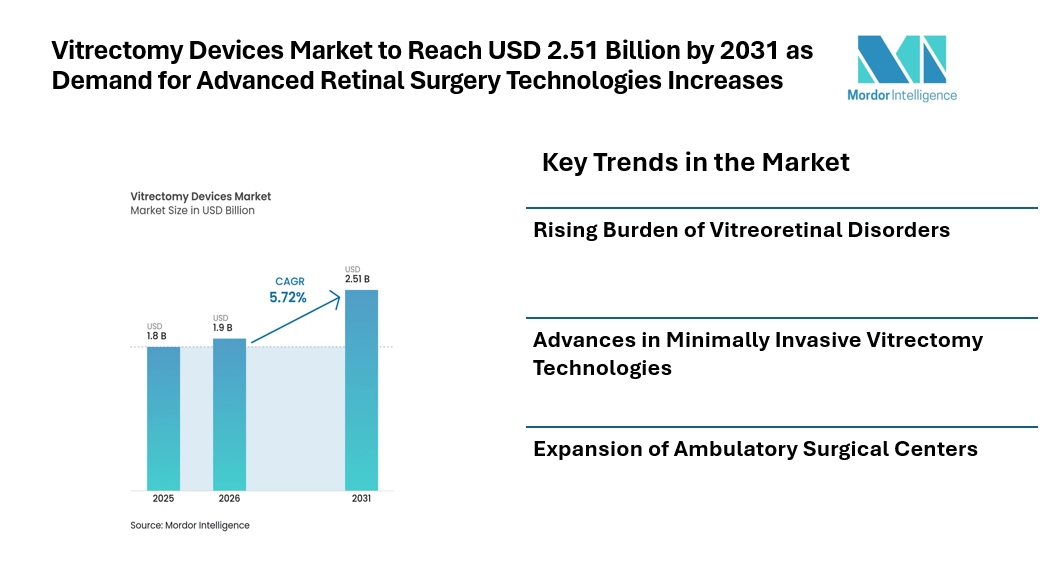
According to Mordor Intelligence, the Vitrectomy Devices Market is estimated at USD 1.9 billion in 2026 and is projected to reach USD 2.51 billion by 2031, registering a CAGR of 5.72% during the forecast period. Market growth is supported by the rising prevalence of vitreoretinal disorders, an aging population, increasing diabetes-related eye complications, and advances in minimally invasive ophthalmic surgery.
Vitrectomy devices are used in surgical procedures to treat conditions affecting the vitreous and retina. These devices include vitrectomy systems, surgical packs, photocoagulation lasers, and specialized instruments. Growing demand for procedures addressing diabetic retinopathy, retinal detachment, macular holes, and vitreous hemorrhage is supporting the adoption of advanced surgical equipment across hospitals and ophthalmology clinics.
North America holds the largest regional share of the vitrectomy devices market, supported by established ophthalmic healthcare infrastructure and early adoption of advanced surgical technologies. Asia-Pacific is expected to register the fastest growth, driven by an expanding patient population, rising awareness of retinal disorders, and investments in eye-care facilities. However, high equipment and maintenance costs, shortages of skilled vitreoretinal surgeons, and regulatory requirements continue to influence market expansion.
Report Overview: https://www.mordorintelligence.com/industry-reports/vitrectomy-devices-market?utm_source=abnewswire
Vitrectomy Devices Market Trends
Rising Burden of Vitreoretinal Disorders
The increasing prevalence of diabetic retinopathy, retinal detachment, and age-related macular degeneration is supporting demand for vitrectomy procedures. Diabetic retinopathy can lead to complications such as vitreous hemorrhage and retinal traction, requiring surgical intervention in advanced cases. The growing diabetes burden is therefore contributing to demand for specialized retinal surgery equipment.
An aging population is further increasing the number of individuals requiring treatment for age-related eye conditions. Healthcare providers are investing in advanced vitrectomy systems and instruments to manage complex retinal disorders and support vision preservation. Greater awareness and improved diagnosis are also helping patients access appropriate treatment.
Advances in Minimally Invasive Vitrectomy Technologies
Minimally invasive vitrectomy techniques are gaining adoption as surgeons seek to reduce surgical trauma and improve patient recovery. Small-gauge instrumentation allows procedures to be performed through smaller incisions, supporting reduced postoperative discomfort and shorter recovery periods.
Hypersonic vitrectomy technology is also attracting attention because it uses high-frequency cutting mechanisms to support vitreous removal. Improvements in fluidics, visualization, and surgical instrumentation are helping manufacturers differentiate their products. These developments are supporting the replacement of older systems with advanced platforms across ophthalmic facilities.
Expansion of Ambulatory Surgical Centers
The growing role of ambulatory surgical centers is creating additional demand for vitrectomy devices. Improvements in surgical technologies and outpatient care models are allowing selected vitreoretinal procedures to move beyond traditional hospital operating rooms. Compact systems and efficient surgical workflows are becoming increasingly relevant for facilities seeking to manage procedures in outpatient settings.
Ophthalmology clinics are also gaining importance as specialized providers expand their surgical capabilities. The demand for portable equipment and procedure-specific consumables is creating opportunities for manufacturers serving these healthcare settings.
Increasing Preference for Single-Use Instruments
Infection-control requirements are supporting the adoption of single-use ophthalmic instruments and pre-sterilized surgical packs. Disposable products can reduce the need for reprocessing and help healthcare facilities manage instrument handling across procedures.
Vitrectomy packs also provide recurring demand for manufacturers because they contain consumables required during surgery. As hospitals and outpatient facilities focus on infection prevention and operational efficiency, demand for procedure-specific packs and disposable instruments is supporting market development.
Vitrectomy Devices Market Segmentation
The vitrectomy devices market is segmented by product type, application, end user, and geography.
-
By Product Type
-
Vitrectomy Systems
-
Vitrectomy Packs
-
Photocoagulation Lasers
-
Instruments
-
Other Product Types
-
By Application
-
Diabetic Retinopathy
-
Retinal Detachment
-
Macular Hole
-
Vitreous Hemorrhage
-
Other Applications
-
By End User
-
Hospitals
-
Ophthalmology Clinics
-
Ambulatory Surgical Centers
-
By Geography
-
North America: United States, Canada, and Mexico
-
Europe: Germany, United Kingdom, France, Italy, Spain, and Rest of Europe
-
Asia-Pacific: China, Japan, India, Australia, South Korea, and Rest of Asia-Pacific
-
Middle East and Africa: GCC, South Africa, and Rest of Middle East and Africa
-
South America: Brazil, Argentina, and Rest of South America
-
For more insights on the Japanese market report, please visit the Mordor Intelligence page: https://www.mordorintelligence.com/ja/industry-reports/vitrectomy-devices-market?utm_source=abnewswire
Vitrectomy Devices Market Competitive Landscape
The vitrectomy devices industry is characterized by high market concentration, with established ophthalmic medical device manufacturers maintaining strong product portfolios and distribution networks. Competition is driven by technological differentiation, product reliability, surgical performance, and the ability to provide integrated equipment and consumables.
Leading companies are focusing on advanced vitrectomy systems, hypersonic cutting technologies, disposable instruments, and integrated cataract-retina platforms. Product development and regulatory clearances are helping manufacturers expand their offerings across different surgical applications. Companies are also targeting outpatient settings with compact systems and products designed to support efficient procedural workflows.
High capital requirements and the need for specialized technical support create barriers for smaller participants. Manufacturers with established relationships with hospitals, ophthalmology clinics, and surgical centers are positioned to benefit from equipment replacement and expanding procedural demand.
Key Players
The major companies operating in the vitrectomy devices market include:
-
Alcon
-
BVI
-
Bausch + Lomb
-
Carl Zeiss Meditec AG (DORC)
-
Geuder AG
-
Johnson & Johnson Vision
-
NIDEK Co. Ltd.
-
Hoya Surgical Optics
-
Topcon Corporation
-
Leica Microsystems
-
Oertli Instrumente AG
-
Optikon 2000 SpA
-
MedOne Surgical
-
MANI, INC.
-
Oculus Surgical
-
Inami & Co.
-
Rumex International
-
Peregrine Surgical
Conclusion
The vitrectomy devices market is expected to grow as the prevalence of retinal disorders increases and healthcare providers adopt advanced surgical technologies. Demand for vitrectomy systems, surgical packs, and specialized instruments is supported by the growing need for procedures addressing diabetic retinopathy, retinal detachment, and other vitreoretinal conditions.
North America remains the largest regional market, while Asia-Pacific offers significant growth opportunities through expanding healthcare infrastructure and rising demand for retinal care. Although equipment costs and shortages of skilled surgeons remain challenges, advances in minimally invasive surgery, integrated platforms, and single-use instruments are supporting market development. Companies that strengthen their product portfolios and address the needs of hospitals, ophthalmology clinics, and ambulatory surgical centers will remain important participants in the vitrectomy devices industry.
About Mordor Intelligence
Mordor Intelligence is a global market intelligence firm, founded in 2014, helping businesses make informed decisions through data-driven insights, industry expertise, and advanced analytics. With 550+ domain experts and on-ground specialists across 150+ countries, the company delivers comprehensive intelligence across aerospace & defense, agriculture, automation, automotive, chemicals & materials, consumer goods & services, electronics, energy & power, financial services, food & beverages, healthcare, hospitality & tourism, information & communications technology, and logistics.
Its offerings include syndicated industry reports and subscription platforms such as Synapse. Mordor Intelligence is ISO 9001:2015 and ISO/IEC 27001:2022 certified, a member of ESOMAR and the Market Research Society of India, and a four-time Great Place to Work® honoree. Learn more at mordorintelligence.com.
Media Contact
Company Name: Mordor Intelligence Private Limited
Contact Person: Jignesh Thakkar
Email: Send Email
Phone: +1 617-765-2493
Address:11th Floor, Rajapushpa Summit, Nanakramguda Rd, Financial District, Gachibowli
City: Hyderabad
State: Telangana 500008
Country: India
Website: https://www.mordorintelligence.com/


