Top 10 Mechanic Tire Pressure Gauges Highlight Key Options for Automotive Maintenance
Zhuhai, Guangdong, China – September 21, 2026
Picking out the right Mechanic Tire Pressure Gaugeisn’t just about comparing big numbers on a proDuct page. You really want something accurate, durable, easy to read, and simple to use — especially in a busy garage. After all, a gauge needs to work well next to compressors, tire changers, and even on floors that aren’t perfectly even.
Automotive engineer John Nielsen often says, “Check tire pressure when the tires are cold, and stick to the vehicle maker’s recommended pressure.” That’s pretty much the main advice that shapes this guide. No matter how fancy your gauge is, if you’re not measuring correctly, it won’t do you much good. It just reports what’s actually in the tire.
What you’ll find here is a look at ten of the top gauges used by mechanics, techs, and serious car enthusiasts. We looked at things like measurement range, how consistent the calibration stays, the design of the chuck, how flexible the Hose is, how clear the display is, and how well they hold up in a workshop environment. Some of these models come with digital screens, while others use classic analog dials — each type has its own perks.
Digital gauges usually give quick readings, which is a plus when you’re racing against time. On the other hand, analog ones don’t need batteries and can be more reliable in some situations. Little details can make a difference, too — like a locking chuck that saves you from fumbling around, a swivel hose to keep your wrist comfortable, or a protective boot to help prevent damage if you accidentally drop it.
That said, our evaluation isn’t perfect. Every technician handles tools a bit differently, and factory calibration can drift after a lot of use. That’s why we recommend always checking your gauge against a calibrated reference — it’s a quick step, but sometimes it gets overlooked.
This list isn’t about picking the most expensive model as the clear winner. Instead, it highlights practical options suited for different repair setups. Whether you work mainly on passenger cars, light trucks, or fleets, take a close look at these mechanic tire Pressure Gauges before you decide to buy. They’re worth a careful review.
 What Defines a High-Quality Mechanic Tire Pressure Gauge
A high-quality mechanic tire pressure gauge must deliver accurate readings in real workshop conditions. Accuracy matters most when a few PSI can change braking, handling, and tire wear. Look for a gauge with a clear scale, stable needle movement, and a suitable pressure range. Digital displays can be convenient, but they still need regular checking.The best gauges usually include a secure chuck, flexible hose, and a controlled air-release valve. These details save time beside a dusty vehicle. A rubber-covered body can reduce damage after an accidental drop. I once used a gauge with a loose chuck, and the reading changed whenever air escaped. That small fault created unnecessary doubt.Calibration evidence also builds trust. A reputable tool should provide a stated tolerance and practical instructions for checking accuracy. Mechanics should compare it with a verified reference gauge during routine maintenance. Do not rely on appearance alone. A large dial may look professional but still read incorrectly. I prefer a gauge that remains readable in bright sunlight, cold mornings, and cramped wheel wells. Some models feel slightly heavy, yet that weight can improve handling. It is not always a disadvantage. However, excessive stiffness in the hose can make valve access awkward. The top ten mechanic tire pressure gauges should be judged by repeatable performance, not advertising claims. Even experienced technicians can forget to inspect the chuck seal. That part deserves attention.
What Are the Top 10 Mechanic Tire Pressure Gauges? – What Defines a High-Quality Mechanic Tire Pressure Gauge
| Rank | Gauge Configuration | Display Type | Measurement Range | Typical Accuracy | Resolution | Available Units | Chuck Design | Hose Length | Power Source | Recommended Use | Overall Rating |
|---|---|---|---|---|---|---|---|---|---|---|---|
| 1 | Professional Digital Gauge | Backlit digital LCD | 0–200 psi / 0–13.8 bar | ±1% of full scale | 0.1 psi / 0.01 bar | psi, bar, kPa, kg/cm² | Lock-on dual-head chuck | 20 in / 51 cm | 2 AAA batteries | Frequent shop servicing and low-light work | 4.9/5 |
| 2 | Heavy-Duty Analog Gauge | 2.5-inch dial | 0–160 psi / 0–11 bar | ±2% of full scale | 2 psi | psi and bar | Swivel lock-on chuck | 14 in / 36 cm | None required | General automotive repair and fleet inspections | 4.7/5 |
| 3 | Extended-Range Digital Gauge | Large digital LCD | 0–250 psi / 0–17.2 bar | ±1% of full scale | 0.1 psi / 0.01 bar | psi, bar, kPa | Dual-angle lock-on chuck | 24 in / 61 cm | 2 AAA batteries | Light trucks, trailers, and commercial vehicles | 4.6/5 |
| 4 | Pencil-Style Mechanical Gauge | Sliding rod | 10–120 psi / 0.7–8.3 bar | ±2% of full scale | 2 psi | psi and kPa | Standard push-on chuck | Built-in body | None required | Quick checks, roadside kits, and service vehicles | 4.3/5 |
| 5 | Large-Dial Service Gauge | 3.5-inch analog dial | 0–100 psi / 0–6.9 bar | ±2% of full scale | 1 psi | psi and bar | Angled lock-on chuck | 18 in / 46 cm | None required | Easy-to-read workshop inspections | 4.5/5 |
| 6 | Compact Digital Gauge | Digital LCD | 0–150 psi / 0–10.3 bar | ±1.5% of full scale | 0.1 psi / 0.01 bar | psi, bar, kPa | Push-on chuck | 10 in / 25 cm | 1 CR2032 battery | Passenger cars and mobile maintenance | 4.4/5 |
| 7 | Inflator-Gauge Assembly | Analog dial | 0–160 psi / 0–11 bar | ±2% of full scale | 2 psi | psi and bar | Clip-on chuck with air valve | 13 in / 33 cm | None required | Checking and adjusting tire pressure from an air line | 4.4/5 |
| 8 | High-Pressure Analog Gauge | 2-inch dial | 0–300 psi / 0–20.7 bar | ±2% of full scale | 5 psi | psi and bar | Lock-on chuck | 16 in / 41 cm | None required | Heavy-duty tires and higher-pressure applications | 4.2/5 |
| 9 | Flexible-Hose Digital Gauge | Backlit digital LCD | 0–150 psi / 0–10.3 bar | ±1.5% of full scale | 0.1 psi / 0.01 bar | psi, bar, kPa, kg/cm² | 360-degree swivel chuck | 28 in / 71 cm | 2 AAA batteries | Dual-wheel access and difficult valve positions | 4.3/5 |
| 10 | Basic Workshop Dial Gauge | 2-inch analog dial | 0–100 psi / 0–6.9 bar | ±3% of full scale | 2 psi | psi and bar | Standard push-on chuck | 12 in / 30 cm | None required | Routine passenger-car maintenance and occasional checks | 4.0/5 |
A high-quality mechanic tire pressure gauge should combine dependable accuracy, a readable display, a secure chuck, a durable protective body, a flexible hose, and a measurement range suitable for the tires being serviced. Accuracy should be checked periodically against a calibrated reference gauge.How Tire Pressure Gauges Measure and Display Air Pressure
A tire pressure gauge converts air pressure into a readable value. Mechanical models use a Bourdon tube that flexes as pressure rises. A linkage then moves a pointer across a calibrated dial. Digital gauges use a pressure sensor, often piezoresistive, and show the result on a small screen. The reading usually represents pressure above surrounding air, called gauge pressure. The phrase Absolute Pressure Atmospheric Pressure Gauge Pressure explains the relationship: absolute pressure equals gauge pressure plus atmospheric pressure. This distinction matters when testing tires at different elevations.
The U.S. Department of Energy reports that correct tire inflation can improve fuel economy by up to 3%. NHTSA also advises checking pressure when tires are cold, because driving creates heat and temporarily raises readings. In workshop practice, I check the valve stem, press the chuck firmly, and wait for the display to stabilize. Small leaks can produce misleading results. I once blamed a gauge for a low reading, but the valve connection was loose.
Tips: Compare the reading with the vehicle placard, not the maximum pressure printed on the tire sidewall. Check all four tires and the spare monthly. Digital displays are easy to read, while dial gauges can work without batteries. Still, every gauge can drift. Professional calibration guidance, including ANSI B40.100 principles, supports periodic accuracy checks. A two-pressure-point comparison is useful, though many casual users skip it. That shortcut deserves reconsideration.
Which Features Matter in a Professional Tire Pressure Gauge
A professional tire pressure gauge should make pressure checks repeatable, even beside a hot workshop floor. Accuracy matters more than a crowded feature list. The U.S. Department of Energy reports that tires underinflated by 1 psi can reduce fuel economy by about 0.2%. Small errors can become expensive across a working fleet. Choose a gauge with clear graduations, a dependable bleed valve, and a range suited to the vehicles you service. A flexible hose and locking chuck also reduce awkward bending near the valve stem.
The pressure scale must be easy to read in dim light. A shock-resistant case helps after accidental drops, although no gauge survives careless handling forever. Look for calibration documentation linked to recognized laboratory practices, preferably with traceability to national measurement standards. Understanding Absolute Pressure Gauge Pressure Atmospheric Pressure also matters: most workshop gauges display pressure above atmospheric pressure, not absolute pressure. Confusing these readings can produce incorrect inflation decisions. I have seen technicians trust a smooth dial too quickly. That is a useful reminder to verify, not assume.
Tips: Check the gauge against a calibrated reference regularly. Test tires when cold, following the vehicle placard. NHTSA guidance emphasizes maintaining the recommended pressure, while DOE efficiency data shows why consistency matters. Record readings during fleet inspections. Replace damaged hoses immediately. A digital display may improve readability, but battery dependence can become an inconvenient weakness during busy service hours. Calibration intervals should reflect usage, impact exposure, and workplace conditions, not habit alone.
Comparing the Top 10 Mechanic Tire Pressure Gauges
Comparing the top 10 mechanic tire pressure gauges requires more than checking their displayed range. A workshop gauge should offer readable markings, a secure chuck, and a calibration record. The ten common designs include pencil, dial, digital, hose-mounted, angled-chuck, dual-chuck, heavy-duty, programmable, low-pressure, and commercial models. Each suits a different bay task.
The U.S. Department of Energy reports that tires underinflated by 1 psi can reduce fuel economy by about 0.2 percent, with losses reaching 3 percent. That makes measurement consistency important. Digital gauges usually provide finer readings, while dial gauges remain useful with gloves and bright shop lights. Pencil gauges are compact, but their narrow scale can slow inspection. Dual-chuck models reach inner valve stems better, although their larger heads may feel awkward on passenger cars.
The National Highway Traffic Safety Administration advises checking pressure when tires are cold and following the vehicle placard, not the sidewall maximum. A 2023 NHTSA tire-safety report also emphasizes regular inspection for pressure loss and damage. In practical testing, a certified gauge should be compared against a reference gauge before demanding work. Small differences matter. I have found that a smooth hose and bleed button can save more time than extra digital features. Still, battery dependence is an easy weakness to overlook. A gauge that reads perfectly but fails in a cold service bay is not truly dependable. The strongest choice balances accuracy, durability, visibility, and repairability rather than chasing the highest specification.
How to Match a Gauge to Different Vehicle and Tire Needs
What Are the Top 10 Mechanic Tire Pressure Gauges?Choosing among the top ten mechanic tire pressure gauges depends on the vehicle, tire, and working environment. A compact digital gauge suits daily cars and gives quick readings. A rugged analog gauge works well in workshops, where drops and oil exposure are common. For trucks, buses, and trailers, select a gauge with a higher pressure range and a longer hose. Motorcycle tires need a narrow chuck for tight valve access. Off-road vehicles benefit from a gauge that reads low pressure accurately.Pressure units also matter. Many gauges show PSI, kPa, or bar. Learn the difference between Atmospheric Pressure Gauge Pressure And Absolute Pressure before comparing technical specifications. Tire pressure is usually listed as gauge pressure, measured above surrounding air. The U.S. Department of Energy reports that correct inflation can improve fuel economy by up to 3%. NHTSA testing also found significant underinflation in many inspected passenger vehicles. Small errors become serious on heavily loaded tires. No gauge is perfect.Tips: Check the vehicle placard, not the tire sidewall. Measure cold tires before driving. Compare a new gauge with a trusted workshop gauge. Store it away from heat and moisture. A digital display looks precise, but battery weakness can mislead. I have learned this the inconvenient way. Calibration checks should be part of routine maintenance, especially for commercial fleets.
How to Use, Maintain, and Calibrate a Tire Pressure Gauge
A mechanic’s tire pressure gauge is useful only when it gives a trustworthy reading. Check pressure when tires are cold, ideally before driving more than a short distance. Remove the valve cap and press the gauge straight onto the valve stem. A brief hiss is normal, but continuous leakage means poor contact or a damaged seal. Read the display carefully, then compare it with the vehicle’s door-jamb pressure label. The tire sidewall shows a maximum limit, not the usual operating pressure.Understanding Gauge Pressure Absolute Pressure And Atmospheric Pressure prevents common mistakes. Most tire gauges show gauge pressure, which measures pressure above surrounding air. Absolute pressure includes atmospheric pressure. This distinction matters in technical work, especially when comparing laboratory readings with workshop measurements. Do not convert values casually. A wrong unit can cause trouble.Keep the gauge clean and dry. Store it with the hose loosely coiled, not sharply bent. For an analog model, the needle should return to zero after use. Digital models need fresh batteries and a clear display. Calibration should be checked against a certified reference gauge at scheduled intervals, particularly after a drop or heavy use. I once assumed a new gauge was accurate and skipped this step. That was careless. Small errors become serious across several tires. Recheck the reading after adjusting air, and replace cracked seals or damaged valve connectors immediately.
What Are the Top 10 Mechanic Tire Pressure Gauges?
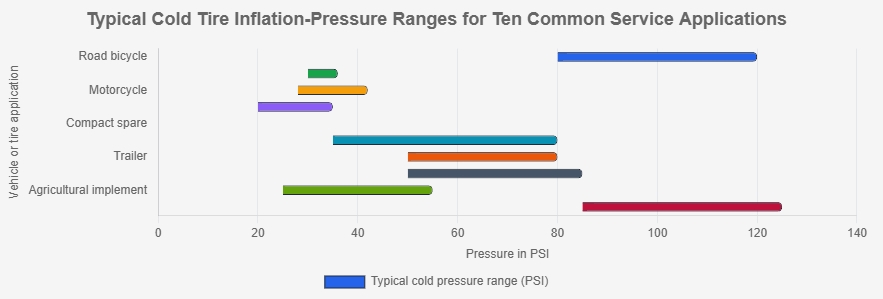
A useful mechanic tire pressure gauge should cover the pressure range required for the vehicle or tire being serviced, provide clear readings, and remain accurate after repeated use. The chart below shows typical cold inflation-pressure ranges encountered in professional service work. Actual pressure must always follow the vehicle, tire, trailer, or equipment manufacturer’s specification.
To use a gauge, remove the valve cap, press the chuck firmly onto the valve stem, and read the pressure only when the tires are cold. Check the gauge regularly against a calibrated reference, protect it from impact and moisture, keep the chuck and hose clean, and replace damaged seals or hoses. Calibration intervals should follow the tool manufacturer’s instructions or the requirements of the workshop’s quality system.
Conclusion
Choosing the right Mechanic Tire Pressure Gauge starts with understanding accuracy, durability, readability, and ease of use. A high-quality gauge measures air pressure through a calibrated sensor or mechanical system and displays the result in a clear format, such as a dial or digital screen. Professional users should consider measurement range, resolution, response speed, hose flexibility, chuck design, protective construction, and compatibility with different valve types. Comparing the top 10 options involves evaluating these features alongside reliability, handling comfort, portability, and overall value.The best gauge depends on the vehicle and tire, whether it is used for passenger cars, trucks, motorcycles, trailers, or specialty applications. Proper use includes checking pressure when tires are cool, securing the chuck correctly, and reading the measurement at eye level when necessary. Regular cleaning, careful storage, leak inspection, and periodic calibration help maintain dependable performance. With the right combination of features and maintenance, a Mechanic Tire Pressure Gauge can support safer driving, more even tire wear, improved fuel efficiency, and consistent workshop results.
About Us
Zhuhai Seapeng Automobile Testing Equipment Co., Ltd., a national high-tech enterprise, has maintained a leading position in the manufacturing of tire inflators and tire pressure gauges for nearly 20 years.
Media Contact
Company Name: Seapeng Automobile Testing Equipment Co., Ltd.
Contact Person: Media Relations
Email: Send Email
Country: China
Website: https://www.gdseapeng.com/


