Digital Asset Custody Market to Hit USD 2.12 Trillion by 2031 as Institutional Adoption, Regulatory Recognition and Tokenized Assets Drive Growth, Says Mordor Intelligence
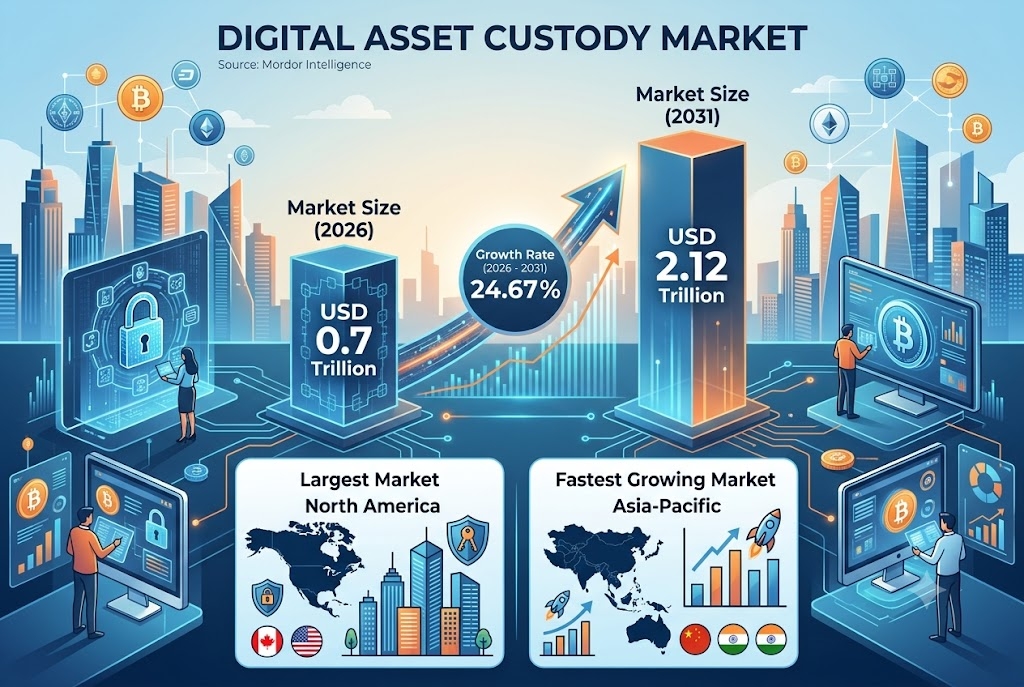
Hyderabad, India, October 02, 2026: According to Mordor Intelligence: The digital asset custody market size is expected to increase from USD 0.65 trillion in 2025 to USD 0.70 trillion in 2026 and reach USD 2.12 trillion by 2031, growing at a CAGR of 24.67% over 2026-2031. The market is being supported by increasing institutional participation in digital assets, clearer regulatory treatment for qualified custody models, growing demand for auditable key management, and the integration of custody into tokenized settlement and financial infrastructure.
The market is moving beyond cryptocurrency safekeeping as banks, asset managers, corporates, and other institutional users seek custody arrangements that combine asset protection with compliance, reporting, settlement, and asset utilization capabilities. Regulatory developments are also allowing traditional financial institutions to participate more directly in digital asset custody, creating greater competition between established financial institutions, crypto-native custodians, and hybrid providers.
The Digital Asset Custody Market Share is also being influenced by the growing institutional use of regulated investment products and tokenized financial assets. Custody providers are increasingly required to support multiple asset types, jurisdiction-specific compliance requirements, and institutional operating processes, making custody infrastructure an important part of the broader Digital Asset Custody Industry.
Digital Asset Custody Market Growth Drivers
Institutional Allocation to Digital Assets Strengthens Custody Demand
Institutional allocation to cryptocurrencies and tokenized assets is increasing the need for professionally managed custody infrastructure. Investment funds, financial institutions, and corporate treasury teams require secure arrangements that provide private key control, asset segregation, audit readiness, and operational oversight.
The expansion of regulated digital asset investment products is strengthening this requirement because institutional products depend on qualified custody arrangements for underlying assets. As institutional participation becomes more integrated with conventional financial services, custody relationships are increasingly being treated as long-term infrastructure rather than a supporting function for trading activity.
Regulatory Recognition Supports Traditional Financial Institution Custody
Regulatory recognition is becoming an important factor in the Digital Asset Custody Market Trends. Clearer rules around qualified custody and bank participation are allowing traditional financial institutions to develop or expand digital asset custody offerings.
This creates greater opportunities for banks and established custodians that already have compliance, legal, reporting, and risk management systems. At the same time, regulatory requirements increase the operational standards that providers must meet. Custodians serving institutional clients therefore need documented controls, asset segregation procedures, strong governance, and jurisdiction-specific compliance capabilities.
Security, Insurance and Auditable Key Management Remain Core Requirements
Security remains central to digital asset custody because institutional clients require protection against unauthorized access, operational errors, cyber threats, and key-management failures. Providers are using approaches such as multi-party computation, hardware security modules, cold storage, and controlled access procedures to strengthen custody infrastructure.
Insurance coverage and audit readiness are also becoming important purchasing considerations. Institutional clients increasingly expect custody providers to demonstrate documented security controls rather than relying only on general security claims. This is raising the importance of certification, operational processes, reporting capabilities, and risk management across custody relationships.
Tokenized Settlement Expands the Role of Custody Providers
The growing use of tokenized money, securities, and other financial instruments is broadening the role of custodians. As digital assets become part of settlement and collateral workflows, custody providers are being positioned closer to transaction execution and asset movement.
Near-real-time settlement requirements are creating demand for infrastructure that can connect custody with settlement, collateral management, and transaction controls. Cross-chain support is also becoming relevant as institutional users seek to manage assets across different networks while maintaining consistent compliance and operational standards.
Check out more details and stay updated with the latest industry trends, including the Japanese version for localized insights: https://www.mordorintelligence.com/ja/industry-reports/digital-asset-custody-market
Digital Asset Custody Market Segmentation
The Digital Asset Custody Market is segmented by custody provider type, asset class, service layer, end user, and geography. Each segment reflects different institutional requirements, security expectations, and regulatory conditions.
By Custody Provider Type:
-
Traditional Financial Institution Custodians
-
Crypto-Native Qualified Custodians
-
Hybrid Custody Providers
Crypto-native qualified custodians continue to serve institutional cryptocurrency workflows, while traditional financial institution custodians are expanding their role as regulatory and accounting conditions become more supportive. Hybrid providers are combining technology-led infrastructure with regulated custody structures.
By Asset Class:
-
Cryptocurrencies
-
Tokenized Real-World Assets and Digital Securities
-
Non-Fungible Tokens and Other Digital Assets
Cryptocurrencies remain the foundation of custody demand, while tokenized real-world assets and digital securities are creating additional requirements around ownership records, transfer controls, compliance, and institutional servicing.
By Service Layer:
-
Core Custody and Safekeeping
-
Value-Added and Ancillary Services
Core custody remains essential for secure storage and asset control, while additional services such as staking, governance, collateral management, reporting, and settlement support are expanding the role of custody providers.
By End User:
-
Traditional Financial Institutions
-
Asset Managers and Investment Funds
-
Corporates and Treasuries
-
Other Institutional Users
By Geography:
-
North America
-
South America
-
Europe
-
Asia-Pacific
-
Middle East and Africa
North America remains a major market, while Asia-Pacific is identified as the fastest-growing region during the forecast period.
Explore Our Full Library of Financial Services and Investment Intelligence Research Reports: https://www.mordorintelligence.com/market-analysis/financial-services-and-investment-intelligence?utm_source=abnewswire
Digital Asset Custody Market Key Players
The competitive landscape includes established financial institutions, crypto-native custody specialists, and technology-focused providers. Competition is increasingly based on regulatory standing, security architecture, supported assets, institutional reporting, network connectivity, and the ability to provide services beyond basic safekeeping.
Major companies covered in the Digital Asset Custody Market include Coinbase Global, Inc., BitGo, Inc., Anchorage Digital Bank N.A., Fidelity Digital Asset Services, LLC, and The Bank of New York Mellon Corporation. These companies are positioned across different parts of the custody ecosystem, with offerings covering institutional safekeeping, digital asset infrastructure, regulated custody, and broader financial services.
Digital Asset Custody Market Outlook
The Digital Asset Custody Market is moving toward a broader institutional infrastructure model in which secure asset storage is combined with compliance, reporting, settlement, collateral management, and asset utilization. Growing institutional participation and regulatory recognition are creating opportunities for both traditional financial institutions and specialist custody providers.
Future market development will depend on the ability of custodians to maintain strong security controls, support expanding asset classes, manage regulatory requirements across jurisdictions, and connect custody services with tokenized financial workflows. As institutional adoption continues, providers with robust operating controls and comprehensive custody capabilities will remain central to the development of the global Digital Asset Custody Industry.
For more insights on this market, please visit the Mordor Intelligence page: https://www.mordorintelligence.com/industry-reports/digital-asset-custody-market?utm_source=abnewswire
Explore More Research Reports from Mordor Intelligence:
Asset Management Market Size: The Asset Management Market was valued at USD 156.07 trillion in 2025 and is projected to increase from USD 169.87 trillion in 2026 to USD 245.12 trillion by 2031, registering a CAGR of 7.61% during the forecast period (2026-2031). The market is being supported by broader household participation in capital markets, expanding defined-contribution retirement assets, and continued institutional allocation toward private credit, infrastructure, and other illiquid investment strategies.
United States Asset Management Market Size: The United States asset management market is projected to grow from USD 70.97 trillion in 2026 to USD 125.98 trillion by 2031, registering a CAGR of 12.16% during the forecast period. Growing adoption of AI is moving asset managers beyond workflow automation toward data-driven decision-making, supporting product development and creating new fee models across public and private investment strategies.
Get more insights on United States Asset Management Market: https://www.mordorintelligence.com/industry-reports/usa-asset-management-industry?utm_source=abnewswire
About Mordor Intelligence:
Mordor Intelligence is a trusted partner for businesses seeking comprehensive and actionable market intelligence. Our global reach, expert team, and tailored solutions empower organizations and individuals to make informed decisions, navigate complex markets, and achieve their strategic goals.
With a team of over 550 domain experts and on-ground specialists spanning 150+ countries, Mordor Intelligence possesses a unique understanding of the global business landscape. This expertise translates into comprehensive syndicated and custom research reports covering a wide spectrum of industries, including aerospace & defense, agriculture, animal nutrition and wellness, automation, automotive, chemicals & materials, consumer goods & services, electronics, energy & power, financial services, food & beverages, healthcare, hospitality & tourism, information & communications technology, investment opportunities, and logistics.
For any inquiries or to access the full report, please contact:
https://www.mordorintelligence.com/
Media Contact
Company Name: Mordor Intelligence
Contact Person: Jignesh Thakkar
Email: Send Email
Phone: +1 617-765-2493
Address:11th Floor, Rajapushpa Summit, Nanakramguda Rd, Financial District, Gachibowli [email protected]
City: Hyderabad
State: Telangana 500008
Country: India
Website: https://www.mordorintelligence.com/


